In an era where digital innovation is critical, insurance companies are at risk of being left behind because of outdated systems. While once essential, these legacy core applications are now hampering essential innovations, particularly in advanced data analysis and customer interaction. In a rapidly changing market, the need to renew these systems is more urgent than ever. Companies in the insurance industry find themselves caught in a paradox: sticking to outdated systems means a missed opportunity for personalized services, while automation costs, which average 6.9% of turnover, will continue to rise by an average of 10% over the next three years (Adfiz Advies in figures 2022/2023). This cost increase is so high that it limits the flexibility and growth capacity of companies. That is why a good insight into the Total Cost of Ownership (TCO) of software is essential. A look at these figures shows that a review of the technological agenda is urgently needed, not only to reduce the costs of software, but also, above all, to actually get software-based innovation off the ground.
Insurance
How do you lower the TCO of insurance software?
Strategic cost management: TCO in the insurance industry
TCO offers a comprehensive view of the costs of a system or application. An important cost here is the licensing costs. In addition, the TCO includes management, maintenance, upgrades and investments in implementation, maintenance and upgrades. If there is innovation, the TCO comes with initial investments such as additional licenses for new software, conversion, consultancy and other forms of training.
A good overview of the TCO of software not only provides decision makers in the insurance industry with clarity about the immediate purchase costs in the short term, but also, above all, the long-term impact of technology investments. By the way, this insight is always limited, if only because you can never properly assess what it will cost you if you don't change anything. What is certain is that limited flexibility and innovation combined with rising costs for licensing and management are a dangerous cocktail. Especially considering the rapid developments in the insurance market where insurtechs and clients' digital preferences will sooner or later lead to disruption.
Licenses linked to turnover
In the insurance market, licenses are often linked to the number of policies in administrations that are managed with this software. In itself, you often see such a pricing model that is based on customers' turnover in the software industry. In revenue-based pricing, the cost of the licenses is linked to customer success or growth. This can be attractive for start-ups or smaller companies that are not yet generating large revenues. The idea is that as the customer grows and makes more turnover, they also make more use of the software and therefore pay more.
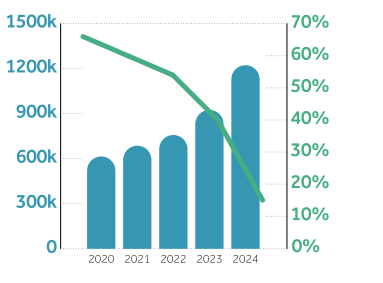
But in the case of the insurance market, where a limited number of software providers put insurance software in a market that also consolidates, things are quite different. The problem is that the licensing models based on the number of policies and premium-based licensing models put considerable pressure on operational costs. Not only do the high licensing costs keep operational costs high, they also limit the flexibility of customers to reduce other operational costs by streamlining processes and using data to increase sales. This dynamic highlights the need for insurance companies to take a closer look at the overall TCO of the application stack and, in particular, the licensing costs, as you can see in the example below.
Figure 1. Impact of discounts on licensing costs.
Figure 1 shows the impact of a revenue-based licensing model. It shows how licensing costs are reduced at the start of a discounted agreement. Once customers are lured with attractive discounts, these licensing costs increase significantly over the years. In itself, this seems like a very customer-friendly offer where the customer is rewarded for initial trust and commitment. This leads to a situation where the customer, caught in a web of initially attractive conditions, faces increasing costs that undermine the original value proposition. Especially because the added value of the software is certainly not getting better due to the inflexibility for the customer.
Savings potential licenses
Every disadvantage has its advantage. A business case applied in practice has shown that the switch to a licensing model based on actual use results in significant cost savings of a few tens of percent. In contrast to the revenue-based model, which is tied to business performance, the usage-based model provides a direct link between costs and actual usage, leading to a more efficient cost structure. With the new supplier, companies only pay for the licenses they actually use, which can lead to a more efficient allocation of resources. As a result, the switch to a usage-based licensing model not only offers significant cost savings, but also improved flexibility and scalability. The cost savings last even if implementation costs and operational adjustments are included in the comparison, as shown in figure 2.
Figure 2. Even with migration costs included, the switch is quickly recouped.
The shift to a usage-based licensing model is a critical step for insurance companies that aim to cut costs and increase their organizational flexibility. This approach not only provides a direct link between costs and actual usage, but also promotes a more predictable and manageable TCO. Given the rapid changes in the insurance industry, it is essential that companies choose a licensing model that supports their growth and innovation without facing unexpected costs or restrictions.
An important intervention to achieve TCO optimization is therefore the switch to licensing models that are based on actual use. Indeed, these models offer a dynamic and scalable cost structure, allowing companies to adapt more quickly to market changes. The benefits of this approach, as highlighted in the table below, lie in the direct correlation between cost and usage, which promotes innovation and supports strategic growth. This is an important aspect of the added value of usage-based licensing models, but it is not the only thing.
Aspect
Omzet gebaseerd licentiemodel
Op gebruik gebaseerd licentiemodel
Kostenstructuur
Kosten zijn gekoppeld aan het aantal polissen of de premieomzet.
Kosten zijn gebaseerd op het aantal actieve gebruikers van de software.
Schaalbaarheid
Minder flexibel, kosten kunnen snel stijgen bij groei in polisaantallen of premieomzet.
Flexibeler, kosten zijn gerelateerd aan het daadwerkelijke gebruik.
Voorspelbaarheid
Kosten kunnen fluctueren met de marktdynamiek en zijn minder voorspelbaar.
Kosten zijn stabieler en voorspelbaarder, gebaseerd op gebruikersaantallen.
Toegevoegde waarde
Kosten weerspiegelen mogelijk niet het werkelijke gebruik of behoefte.
Kosten zijn meer afgestemd op de werkelijke behoefte en gebruik van de software.
Marktgevoeligheid
Gevoelig voor schommelingen in de verzekeringsmarkt.
Minder directe impact van marktfluctuaties.
Innovatiestimulans
Kan innovatie ontmoedigen door hogere kosten bij uitbreiding van het aanbod.
Stimuleert innovatie door flexibele schaling en aanpassing aan veranderende behoeften.
Administratieve last
Kan complex zijn in beheer, vooral bij fusies en overnames.
Eenvoudiger in beheer met duidelijke gebruikerslicenties.
Strategische groei
Beperkt strategische groeimogelijkheden door vaste kostenstructuur.
Ondersteunt strategische groei door kosten aan te passen aan veranderende behoeften.
The impact of innovation on TCO
The flexibility of software solutions and the ability to innovate has a significant impact on both current and future costs as software unlocks opportunities to make existing processes more efficient by detecting inefficiencies and optimizing them to improve operational excellence.
An important key to reducing TCO is the use of process mining, a technique that makes it possible to review business processes, reveals inefficiencies and indicates opportunities for optimization. The importance of digital transformation in this process cannot be overstated, especially in the context of reducing “keeping-the-lights-on” costs. By moving to more advanced, often cloud-based systems, companies can significantly improve operational efficiency.
Platform approach
A platform approach, such as Novulo's insurance platform, offers companies in the insurance market such a new perspective. It makes innovation in insurance software feasible because insurance companies can build a modular ERP that exactly matches business operations. A component store included in this platform offers a wide range of insurance functionality. From this, companies can quickly put together an application that is suitable for them.
du Gardijn, an intermediary that advises companies on business risks such as non-life and income insurance and supplements this offer with its own Occupational Health Service and HRM services, has undergone a significant digital transformation with Novulo's composable insurance software, as this case description shows. This change has led to a reduction in dependence on the ANVA system and the proxy office, giving the company more independence and flexibility. The result is improved efficiency and service delivery, with 20% fewer administrative burdens and the ability to grow without additional staff. du Gardijn's ambition is further supported by data-driven techniques, such as automated email notifications, and reducing repetitive tasks to make room for innovation and more complex challenges. The integrated approach, which includes both process optimization and digital transformation, is essential for companies that want to lower their TCO and strengthen their competitive position.
Your route to a lower TCO
The du Gardijn case study shows that a strategic focus on digitization and process optimization leads to substantial savings and improved business performance. Are you ready to transform your organization by optimizing software TCO?
Latest
Blogs
Insurance
Blogs
Why customers drop off during an online insurance application and how to prevent it
UX-leader Machiel Oskam van Online Department legt uit waarom klanten afhaken tijdens een online verzekeringsaanvraag: verzekeraars vragen gegevens die klanten niet bij de hand hebben. Aan de hand van Maia laat hij zien hoe het beter kan, met maximaal drie stappen tot een prijs.
Insurance
Blogs
How du Gardijn achieves 35% year-on-year growth while the insurance market remains stagnant
Enschede-based intermediary Du Gardijn has achieved three consecutive years of 35% growth without any acquisitions. Director Rowin du Gardijn explains how the firm uses Novulo and AI to automate all back-office processes, freeing up more time for advisors to focus on personal client relationships.
Platform
Blogs
Novulo
Novulo has been named InsurTech of the Year and Disruptor of the Year at the Europe FinTech Awards 2026
Novulo has been named InsurTech of the Year and Disruptor of the Year at the Europe FinTech Awards 2026, recognizing its impact on the insurance industry and the shift from legacy systems to composable software platforms.






.png)
.png)